Sunday, 30 December 2012

IS THERE A WIND POWERED ELECTRICAL GENERATION THREAT TO PALAEOLITHIC SCOTLAND SITE?

A couple of months ago I received notification that a Wind Powered Electrical Generation facility was to be considered for construction on or about our excavations on the Moss of Cruden.

This provided me with the "Quandary of quandaries"

What should come first? :-
1. The identification of the area in question being positively identified as the "Real time" location of "Earliest 
     known human habitation of the British Islands by careful and devoted scientific investigation" which   
     resulted from our findings.                                    
                                                                or
2.    The identification of the area in question being positively identified as the "Real time" location of "Earliest 
     known human habitation of the British Islands without careful and devoted scientific investigation" which   
     resulted from our findings.

  
A recent visit to the allegedly proposed site  has shown much arboreal disturbance by major uprooting of trees along the road line. A non technically supported proposition would be that this had been caused by wind and lots of it.

As a Chartered Electrical Engineer I support the garnering and storing of electrical energy from all natural and economical sources however, I also support the fact that this cannot be done to the detriment of us possibly "Finding ourselves".

Sunday, 23 September 2012


THE BIGGER PICTURE

Attached please find copy of www.snh.gov.uk/docs/A337648.pdf which is in the public domain.

ZONE 9 of the above document seems to provide the foundation for presenting a case for the dating of the soils and therefore the artefacts  retrieved  from the hidden soil horizons which were predicted to exist by an eminent soil scientist and exposed by that soil scientist whilst in the company of myself and another colleague.

Reference to Zone 9 will help to confirm for you the antiquity of our sites of investigation and therefore the age of the artefacts retrieved from the hidden soil horizons found therein .

Requests for funding will be instituted on an emergency basis for the re-opening of our original site of excavation and 4 other selected sites in its relatively close proximity.


Friday, 21 September 2012


NATURAL HERITAGE ZONES: EARTH SCIENCES
(published 2002)

ZONE 9 
NORTH EAST COASTAL PLANE
(attributed to)
(John E. Gordon, R.George Lees, Katherine F. Leys,Colin C.J Macfadyen,
Geeta Puri, Robert Threadgould ,Vanessa Kirkbride.)


Tonight I became acquaint with the above publication.

It appeared to me like a laser beam breaking through a great clutter of past understandings / misunderstandings. 

I believe that it provides the credentials not only for  Dr. E A Fitzpatrick's  work as was published in "Nature"  but for the many years of its neglect!.

I only hope that the Zone 9 North East Coastal Plane evaluation was taken into consideration when the Happisburgh trove was being evaluated.

Watch this space!


Monday, 20 August 2012


FOR INFORMATION

(This is the copy of a letter which I posted on my "Online Archaeology" Palaeolithic Scotland site last July.)

Some of our most noted and respected Archaeological Press Correspondents received a personal e-mail on the subject with a copy of the "Letter to The Editor.

I have never received replies from any of them. Their silence speaks volumes I feel.

What do you think?


LETTER.

Attached for info is copy of a letter to various "National Press Editors" sent a couple of days ago.

I hope that if they do not recognise the significance of what we have uncovered on the "Moss of Cruden" then they might do me the kindness of requesting clarification.

Jack Sneddon.

Sir,
PALAEOLITHIC SCOTLAND AND HIDDEN SOIL HORIZONS
It is with pleasure that I write to your respected paper and it is right that I should do so not only for the benefit of every one on the Planet but especially for my fellow countrymen and women here in Scotland.
Scotland has long been denied the honour of having had an early Palaeolithic heritage. This denial has essentially been carried along through the ages on the premise that Scotland would not supply any human
evidence of early Palaeolithic habitation as any evidence which may have been there would have been scoured away by the glaciers?.

Well, this line of thought may or may not be true for some parts of Scotland but it caries no weight in an area which is proven to have never experienced any late primary glaciation. 

That is to say, today what is known as Morraineless Buchan and containing the Moss of Cruden; did not experience any late primary glaciation and could have been ice free for about 1,000,000 years or more. Oh! it would have been cold; indeed it would have been very cold but it would have been then more of a Tundra landscape encircled at one time by gently sloping and icy uplands.

Over the past 15 years or so, I and others have had the honour and privilege to work with Dr. E.A. Fitzpatrick, Kubiena Gold Medallist in Soil Science; in exploring and excavating “Morraineless Buchan”.
Using Dr. Fitzpatrick’s, now axiomatic work; on “Hidden Soil Horizons” allowed us to retrieve material which proves, until any other motion to the contrary is tabled; that Scotland can take its place with dignity among others as having been in the cradle of human evolution and at much senior level than previously anticipated. 

I will welcome all reasonable queries on this communication but there is still much to tell.
e.g. One of our sites was visited by an extremely well known and internationally respected archaeologist whom I had worked with. They advised that we had to get the geology sorted out! 

We have done this via Dr.Fitzpatrick’s work on Hidden Soil Horizons!.

This same archaeologist presented samples of our excavated materials to other respected Archaeologists at a well known English University and asked if they believed that the specimens were naturally fractured. Their
consensus was No However when they asked where the specimens came from and were advised “N.E. Scotland” they all recanted! 

One must, therefore ask ones self if there is some sort of “Taboo” over the finding anything of an Early Palaeolithic Scotland anywhere in Scotland?.

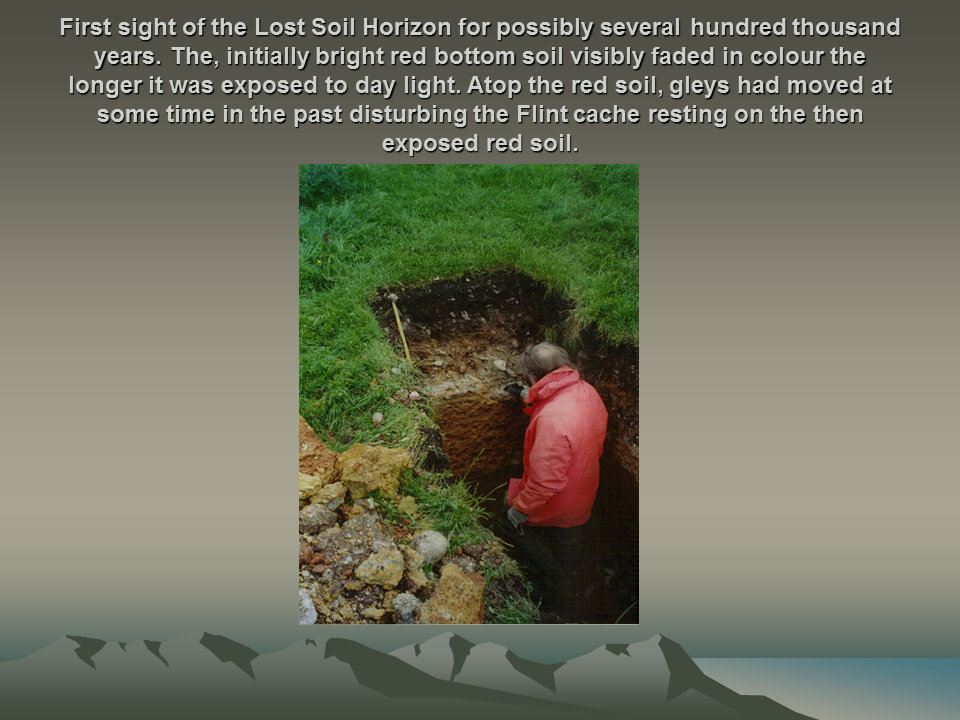
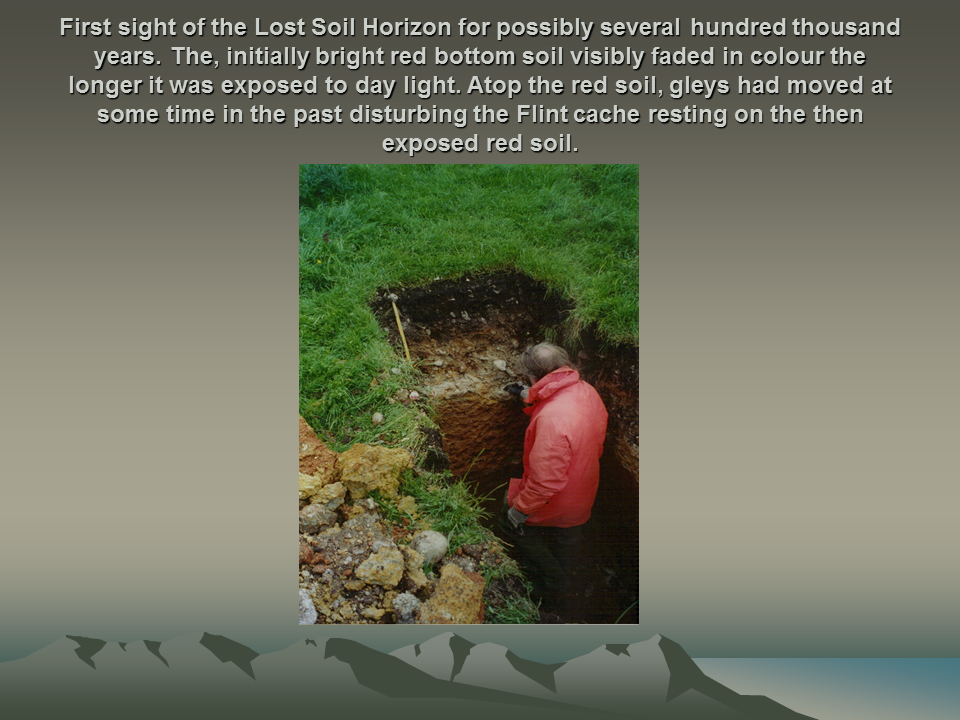
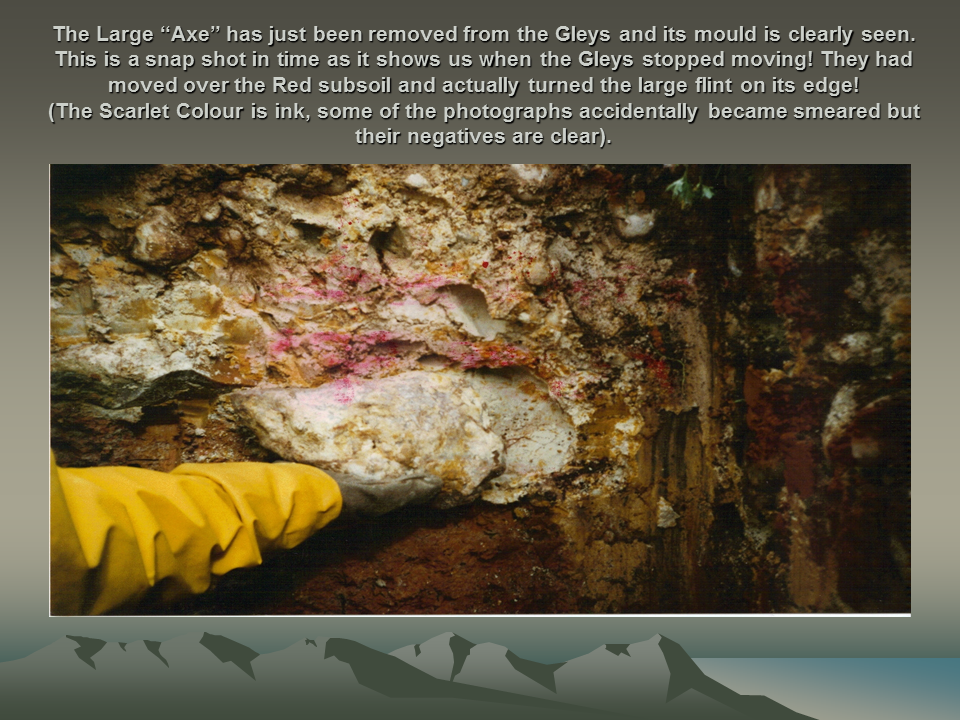
Our findings are significant enough in their own right; but to have excavated them from the bosom of a hidden soil horizon which was probably laid down over 2,000,000 years ago is taking us right back to an era
when some of the horizons found at Olduvai Gorge were being laid down!

In the light of what we have excavated from the Moss of Cruden, it appears that some past opinions regarding N E Scotland being devoid of early Palaeolithic artefacts are in need of a “good deal” of reviewing. 

Some sceptics to our findings are either missing the point or choosing to ignore the fact that when we excavated that day on the Moss of Cruden the selection of the area to be investigated was based on Dr. E A Fitzpatrick’s work on “Hidden Soil Horizons”.I well remember asking Dr. Fitzpatrick where we should set the JCB and him guiding us to a very specific location where he said to me “We’ll go in here Jack!”.

The rest, as some might say; is history. None the less; I am not aware of any other situations, at least within the British Isles; where application of the science relating to hidden soil horizons has been utilised as a tool in the identification of an area worthy of archaeological investigation.

I am convinced that what we uncovered on the Moss of Cruden will allow us to bring Scotland’s heritage out of the neglect it has experienced over the past century or so and have it shown for what it really is i.e. 

" A door to a better understanding of how the Human Race colonised Planet Earth"
.
Jack Sneddon.
07/07/11.

Wednesday, 8 August 2012


EXTRACTS from "PALAEOLITHIC SCOTLAND"
COURTESY of  "ONLINE ARCHAEOLOGY" 


The Rhynie Chert is a petrified Palaeo-wetland/swamp.
It lies about 25 miles to the SW of our excavations at a
similar depth below the topsoil as our hidden Horizon.
"The Rhynie Chert is c.400,000,000 years old"

Reference to Dr. Fitzpatrick's paper to Nature (previous Blog)
will give the moraine limit of northerly transgression of the  "Riss".
                           
Self explanatory

Self Explanatory

Self Explanatory

Self Explanatory
(Please note the carbonised root casts in this photograph)
(THEY DID NOT OCCUR ABOVE THE LITHICS!)

Self Explanatory

We are in the process of trying to achieve funding for the dating of the soils which we exposed via the application of Dr. Fitzpatrick's paper to "Nature" and the independent private, amateur;  investigations which I made around Ellon (Buchan) and on the Moss of Cruden (Buchan). However it is not easy as, being an amateur my status apparently precludes me from completing any forms which might provide us with funding.


Recap!


RECAP!